Historically, I believed the more I worked out and the fitter I was, the healthier I would be at that very moment, and as I got older. So, imagine my surprise about 3 years ago when my body started “falling apart” even though I was in my 30s and teaching and taking fitness classes.
It started with pain in my hip – and off and on physical therapy – then pain in my foot (more physical therapy), tightness in my neck (and spending any money I made from teaching on massages), etc.
As the pandemic ramped up in spring of 2020, I hit a point where exercise made my body feel WORSE than better (red flag!). I wanted there to be a specific medical/fixable reason for this, so I was disappointed when the sports medicine doctor said nothing was torn. He told me it was overuse and to rest.
Rest?! How could I stay FIT if I rested? Part of my identity was being a fitness instructor. Part of my identity was being ‘in shape.’ Although – thanks to therapy and other work, I had made lots of progress when it came to my relationship with food, it was at this moment that I came face to face with the other piece of the body image puzzle: exercise. I was, and had been for a very long time, using exercise to control my body.
I exercised because I felt I “should.”
I felt guilt if I didn’t exercise.
I prioritized calorie expenditure and intensity over enjoyment.
Exercise provided ‘permission’ to enjoy sweets, wine, etc.
You see, for too long, I’ve confused fitness for health. And I don’t think I’m the only one. Companies, magazines, the fitness industry, etc., often teach that fitness and health are synonymous, but they are not.
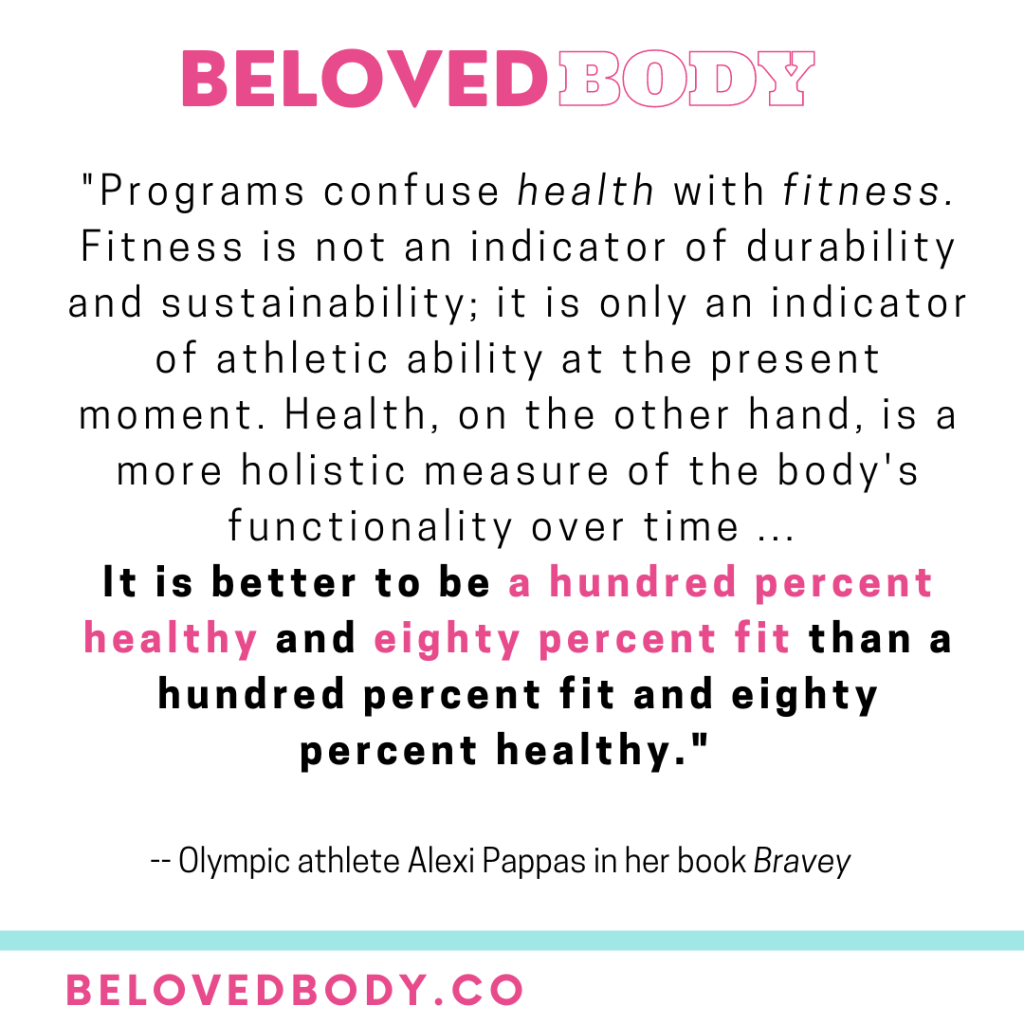
Enter Olympic athlete Alexi Pappas’ powerful explanation in her book Bravey. She says:
“Fitness is not an indicator of durability and sustainability; it is only and indicator of athletic ability at the present moment. Health, on the other hand, is a more holistic measure of the body’s functionality over time. Fitness does not take into account that you need to continue training tomorrow and the next week. It is better to be a hundred percent healthy and eighty percent fit than a hundred percent fit and eighty percent healthy.”
Alexi Pappas, Olympic athlete, actress, director and author of Bravey
A fit body that is in chronic pain isn’t healthy.
A fit body that that requires mental pain – guilt, obsession, not feeling like you’ve done enough – isn’t healthy.
Alexi addresses fitness and health in regard to her running career, and how high school athletic programs often reward fitness, “while health is taken for granted.” She says many female athletes take “shortcuts to fitness at the expense of their long-term health” when they hit puberty (and their body expands, gains weight, changes as it is supposed to do). Quitting running her junior year allowed her body to go through puberty without the strain of overtraining, which ended up helping her running career in the long run.
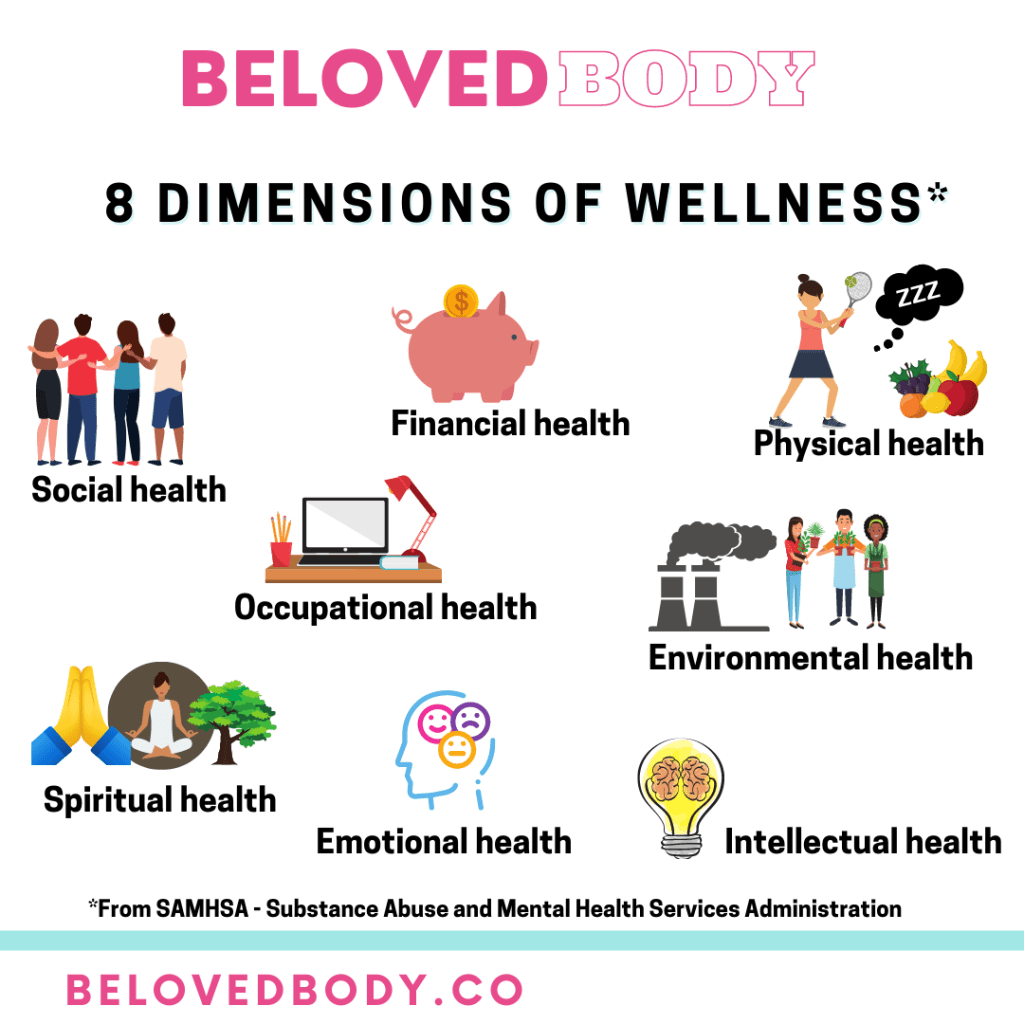
Her health > fitness point has become my mantra, but I’ve taken her concept a step further. Thanks to a health program led by my friend Alex, plus a youth mental health first aid training I did, I’ve learned that health is not just physical health. The Substance Abuse and Mental Health Services Administration outlines 8 dimensions of wellness (in no particular order): 1) social health 2). financial health 3). physical health 4). occupational (job/career) health 5). environmental health 6). emotional health 7). spiritual health 8). intellectual health.
By “falling apart” and “failing me,” my body was actually saving me.
A year and a half ago, most of my eggs where in the physical health basket, but I wasn’t even that physically healthy … I was just fit. By “falling apart” and “failing me,” my body was actually saving me. Hitting my peak pain as COVID ramped up was extremely stressful ( lots of tears and ‘why is this happening now?!?’ moments), but I now realize that timing was a blessing. Gyms shutting down due to COVID allowed me to step away from teaching, which would have been so much harder to do if I had to make that choice solely on my own (I LOVE the people I taught and enjoy the act of teaching). I also discovered an online exercise program called EVLO that launched right as COVID started and was led by a physical therapist. Dr. Shannon Ritchey used to live in Kansas City, and her exercise philosophy and program has helped me evolve my understanding and view of exercise. Her program is:
- Short – 30 – 45 minutes: She’s taught me that a longer workout is not a better workout.
- Science based: She factors in physics and bio-mechanics to select the best moves that won’t compromise your joints. She’s taught me all moves are not created equal – i.e., the risk of some exercises to your joints outweighs the muscular benefits, so they’re not worth doing or as often. Her joint mobility and stability videos help me immensely when my joints get cranky.
- Kind: That may sound silly, but EVLO teaches being kind to our bodies. Never working out from a place of punishment or guilt. She encourages us to listen to our bodies and she CELEBRATES modifications. Our bodies are different. There is no place for shame if we are doing a move differently than her. It’s a positive thing, because it means we are doing what’s best for ourselves.
It took a bit to get used to the mindset of EVLO, but now a year and half after I started, I love it. My body feels so much better, and now that it’s no longer in pain, I can pursue movement that sounds fun: I’ve discovered I enjoy “game” exercises like tennis, and I’ve signed myself up for a tap class. Also, now that my mind is not as focused on exercise, it has space to pursue other areas of passion … like mental health advocacy and this blog.
Today, my ‘eggs’ are spread around more – in the intellectual health basket, the social basket, the emotional health basket, etc., My body has changed and I may not be as fit as I used to be. But if I’m 100% honest with myself, I’m healthier.
And that’s starting to feel pretty good.
-A special thanks to Tiff and Amanda for sharing Bravey with me.


 Beloved Body
Leave a comment